

Coaching isn’t advice. It builds the leadership capacity that shapes wellbeing, culture and performance.
A quiet misunderstanding shaping leadership performance
Coaching has become a familiar part of workplaces, but it is still widely misunderstood.
Too often, coaching is positioned as a place to get answers. A space to solve problems. Sometimes even as a support mechanism for leaders who are struggling.
That framing limits its impact.
When coaching is done well, it is not a reactive intervention. It is a strategic leadership capability builder. One that strengthens how leaders think, decide, and lead in the conditions they actually operate in. Not ideal conditions, but in real ones shaped by pressure, complexity and competing demands.
And this distinction matters more than ever.
The coaching misconception that quietly limits leadership growth.
One of the most persistent assumptions is that coaching provides direction.
Advice can be useful.
Mentoring can be invaluable.
Consulting can accelerate solutions.
Coaching has a different function.
It develops the leader, not just the solution.
The International Coaching Federation defines coaching as a process that supports individuals to maximise their potential through thought-provoking and creative partnership. That definition is important because it shifts coaching away from answers and towards capacity.
In practice, leadership challenges rarely present as a lack of knowledge.
They show up as:
- I’m reacting faster than I’m thinking.
- I’m avoiding difficult conversations.
- I’m carrying more than is sustainable.
- I know what to do, but I’m not doing it consistently.
Often, these patterns are not visible until pressure rises. That’s when leadership is truly tested.
Not all support is the same, and that matters
Different forms of support serve different purposes.
- Mentoring shares experience and helps navigate a path
- Consulting provides expertise and recommends solutions
- Therapy supports mental health and psychological recovery
- Coaching builds the capacity to think, choose, and lead with intention
When these are blurred, coaching is often expected to deliver something it was never designed to do. Not because coaching is limited. But because its role is different.
Coaching is not fixing. It is revealing.
Many leaders enter coaching believing something needs to be fixed.
- Their workload.
- Their confidence.
- Their communication.
- Their team.
And sometimes those things do need attention, but what sits underneath is often more important.
- Patterns of thinking.
- Habits of response.
- Internal narratives that shape behaviour under pressure.
Coaching creates the conditions to see these patterns clearly.
Not with judgement. With awareness.
Awareness is where change begins. Without it, leaders continue to operate from default settings. Even when those settings no longer serve them, their teams, or the organisation.
The real coaching gap: clarity, capability and capacity
There is a common leadership narrative that suggests:
“Leaders already know what to do. The challenge is accessing it under pressure.”
Sometimes that is true, but in many organisations, there is more going on.
Some leaders are still building foundational capability:
- how to lead conversations
- how to create clarity
- how to manage boundaries
- how to navigate conflict constructively
Others have the capability, but not the capacity.
Their cognitive bandwidth is depleted by:
- sustained workload
- constant context switching
- unclear roles or expectations
- systems that have expanded faster than support
Leadership is not tested in ideal conditions. It is shaped in the reality of modern work.
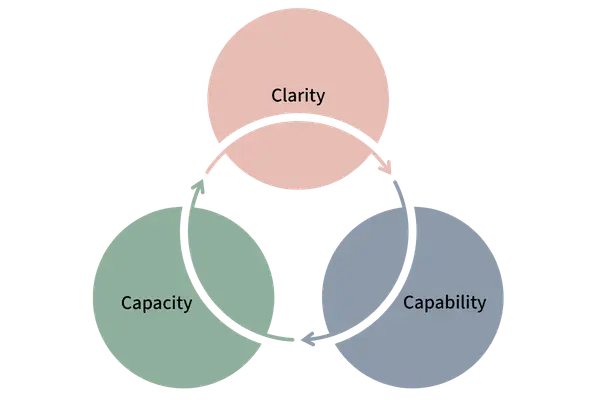
Leadership effectiveness is not driven by capability alone.
It is shaped by the interaction between clarity, capability and capacity.
When capacity is stretched or clarity is reduced, performance narrows even in highly capable leaders.
This is where mental fitness becomes critical.
Not as positive thinking.
Not as a wellbeing add-on.
Not as stress management.
But as a trainable leadership capability.
Frameworks such as Positive Intelligence describe mental fitness as the ability to regulate attention, shift unhelpful patterns, and respond with intention.
This directly shapes how leaders show up in moments that matter.
Because leadership is not defined by what someone knows.
It is defined by how they respond under pressure.
Where coaching reveals the real problem.
This is where the conversation needs to shift.
Coaching builds leadership capacity, but increased capacity does something important. It exposes pressure points, and those pressure points are often not personal. They are structural.
Leaders begin to see:
- workload that is not sustainable
- accountability without authority
- expectations without clarity
- cultures where difficult conversations are avoided
At this point, a critical insight emerges:
Leaders are often not failing. They are compensating for systems that are not designed to support sustainable performance.
This is the turning point.
Where coaching moves from individual development to organisational insight.
Coaching that sticks connects self, structure and sustainability
Self
Building personal leadership, mental fitness and inner resilience. Laying the foundations for success
Structure
Creating the systems and environements that support thriving workplaces.
Sustainability
Embedding sustainable practices that grow with you. Evolving alongside your people and culture.
At Wellbeing by Design Australia, sustainable change is understood through three connected layers:
Self: leadership capacity and mental fitness
This is where coaching often begins.
Attention.
Emotional regulation.
Clarity.
Decision-making.
But when coaching stops here, it can unintentionally place the burden of change on the individual alone.
Structure: systems, work design and culture climate
Leadership does not happen in isolation. It is shaped by the system around it.
In Australia, organisations are increasingly required to manage psychosocial hazards under guidance from Safe Work Australia.
Global research from the International Labour Organisation reinforces that wellbeing at work is shaped by how work is designed, organised and managed.
Psychosocial risk is not only a compliance requirement. It is shaped daily through leadership decisions about workload, clarity, support, and how pressure is managed.
This includes:
- workload and role clarity
- autonomy and support
- change processes
- how conflict is handled
Leaders influence these conditions every day.
Sustainability: embedding performance that lasts
Sustainability is what happens when capability becomes embedded.
It is the difference between:
- insight and behaviour
- intention and consistency
- effort and sustainable performance
It looks like:
- leadership practices that work in real conditions
- teams that recover quickly from pressure
- cultures where wellbeing and performance reinforce each other
The evidence for coaching and leadership performance
A growing body of research, including large-scale meta-analyses in coaching and performance science, shows that coaching contributes to:
- improved performance and skill development
- stronger wellbeing and coping capability
- enhanced goal directed self-regulation
- greater behavioural consistency under pressure
This matters because leadership effectiveness is not about isolated insight. It is about consistent behaviour in complex environments.
The most effective coaching:
- strengthens self-awareness and behaviour change
- aligns with organisational context
- supports application, not just insight
This is why coaching plays a critical role in sustainable performance
The human reality leaders are navigating
Leadership does not exist separately from life, our human context. Many leaders, particularly in midlife, are navigating:
- increased leadership responsibility
- caregiving roles
- health transitions
- evolving identity and career direction
These are not side issues. They shape:
- energy
- confidence
- attention
- decision-making

When coaching recognises the whole person, not just the role, it becomes significantly more effective.
This is where leaders reconect with agency.
Where confidence stabalises, and
Where sustainable performance becomes possible.
A better question for leaders and organisations
A more useful question than “Do we need coaching?”
Is: What kind of capacity are we trying to build?
For leaders:
- Where am I relying on effort instead of capacity?
- What patterns show up when pressure rises?
- What would change if I led from intention more often than urgency?
For organisations:
- Are our systems supporting or constraining leadership?
- Where are leaders compensating for structural gaps?
- Are we embedding wellbeing into how work operates, or adding it on?
Coaching as a strategic lever for performance
Coaching is not advice.
It is not fixing.
It is not a substitute for good systems.
It is a strategic lever.
One that strengthens leadership capacity, reveals system constraints, and supports the design of environments where people and performance can thrive together.
This is where its true value sits.
Designing leadership, not just supporting it
If coaching remains positioned as a reactive support tool, its impact will always be limited, but when it is understood as a way to build capacity, shape systems and embed sustainable performance, it becomes something far more powerful.
A way to strengthen leaders from the inside out.
A way to align wellbeing and performance.
A way to design workplaces where people can lead, contribute and sustain their impact over time.
Next Steps
For Leaders (Individual Pathway)
If you are ready to strengthen your leadership capacity, build mental fitness, and lead with greater clarity, explore the Mental Fitness Foundations program or private coaching pathways
For Organisations
If your leaders are stretched and performance is becoming harder to sustain, this is often a design issue, not a capability issue. Book a Wellbeing by Design strategy conversation to explore how to strengthen leadership, systems, and culture together.